Sunday, 9 October 2011

From Bath

Dear Diane,
I am an obedient friend and so when you told me to have a cream scone for you I had to comply.

And I thought you might like a little something else too...

If this is not enough just let me know because I am here another week and can easily get you more scones.

We are here in Bath for a fortnight in the holiday flat we rent several times a year. I brought lots of creativity related things to do but for the first week have not been exactly productive. It is for example, hard to paint or sew when spending hours at a time floating in thermal waters in the spa! But I have decided that given I tend to be so goal orientated with my creativity,with my Nozbe Ipad app to plan all the projects etc, it is probably necessary to allow myself to take time out and renew from time to time. It is a long time now since I read Julia Cameron's The Artists Way but I do seem to recall that one of her exercises - aimed at writers but adaptable for other art forms - is to take a week off from reading! A whole week!

I can't say I really took a week off from creativity although the only sewing I did for seven days was to finish this twelve by twelve quilt on the theme of Fruit for the Midsomer Quilting Challenge. Did you know that it is really very easy to sew apricots and cranberries?!

WhatI have been doing is dipping into two Danny Gregory books. TheCreatve Licence and and Illustrated Life both about illustrated journals. I decided to allocate this fortnight to trying keeping one out. I have learned that ( a) I can do it and ( b) whilst I have enjoyed the experiment and would not rule out doing the odd page now and again as the whim takes, I quickly meandered back to my own form of journal keeping which is much more word and like scrbble based. So I am now making a declaration on an informed basis, thay I know what kind of journal works best for me and I am going to stick with that despite what other people may declare is a good way to work. I will still enjoy looking at more painterly books and at least I have now slain the ' I can't do a book like that' dragon.

I am embracing the concept of focusing down at the moment. Making as many decisions about what I am not going to be doing as much as what I am going to be doing. I find it is both exhilarating and exhausting that the art quilt world consists of unlimited possibilities and it has been slightly daunting to try and find a niche in that world that is both original and personal. Trying to decidewhat to do is HARD! where do you start?It is so easy to be seduced by new ideas, fabrics, products, inspiration, everywhere I turn. I fear missing out. So I have started to focus on what I am not going to do. Its odd. Its the same decision really but it helps me to phrase it that way.
perhaps because I am not faced with choosing between forty options. It is just one choice. Does this option really excite me? Will it sustain and satisfy me? It is the best thing for me right now? If not, set it aside.

One task for me for this week is to fill in my SAQA visioning page. I know you are not partcipating but I find that kind of life planning deliciously satisfying. In summary I am going to task myself with producing a series of work, using various shows here in the UK as targets to ensure I actually produce and don't shilly shally just playing with ideas then collapsing with indecision. Finished is the aim. I am going to work with two loose, and I anticipate interconnecting sources of inspiration, African Ladies and Kuba cloth, both of which excite me to look at and which seem to provide enough potential variation. And I am declaring it publically here and on SAQA so that I have to stick to it! I am reminding myself that this is only a committment for a year and all the other things that interest me will not go away but await a new year.

After my week of inactivity I went to see Alicial Merritt's works at the Bishops Palace in Bath ( you can see more photos on my blog here). It was fascinating to me that all to shake me out of my hibernation and catapult me, vibrating with excitement, back to the boxes of fabrics stacked in the holiday flat kitchen, was to see this very complete and self assured collection of related works. On my return I started some journal sketches...

Now I have to gather the courage to start and continue, ignoring distractions and slaying fears of mediocracy, persevering through doubt to completion, remembering that success is what I define it.

Brave words. I am expecting to wobble and need to sit with you over a cup of tea and a very chocolately confection and be encouraged. Is that OK? I will reciprocate in whatever way is needed. Not that you seem to get yourself into these crises of purpose and confidence- you seem so much more assured and content to put one foot after the other down whatever path looks good. Can you transfer some of your zen- ness to me perhaps?!

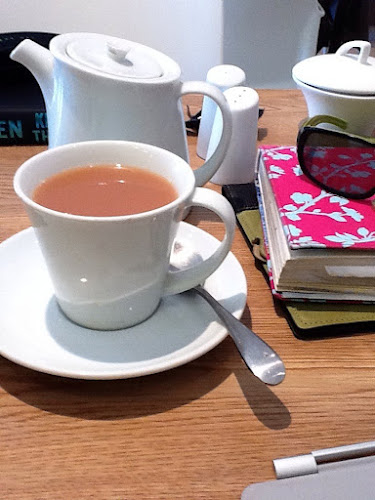
By the way, talking of tea, I can see both the headless jumper wearer and the iron in the teabag. I think its like the old faces in a vase picture. Does it bother you that people see other than what you intended or not?

OK. Time to take my poor man-flu ridden husband to the nearby trattoria for a pile of comforting pasta. After that, some fabric sketches I think with the bits and bobs I have down here. Just playing about.

Helen.

Saturday, 1 October 2011

Retreating


Dear Helen,

I am taking a break from sorting through the unfinished projects in my closet to write this.  Tomorrow, I'll head off to my twice-yearly quilting retreat at the Bishop's Ranch where I'll be hanging out with many of the ladies pictured above. (And I'll be thinking of you and last October when you came with me!)  Because of all of the chatter and social activity, I tend to use the retreat as a place for piecing things I can do without much concentration.  I might machine quilt a project too. 

I think we are mostly agreed on the quilt title issue.  We both agree that the title can richly enhance one's understanding of the quilt.  I've been thinking of your shock upon learning that at some art quilt competitions, the judges didn't know the title of the quilt when they judged it.  My first reaction was that I thought it reasonable to judge the artwork on the imagery alone.  The artist has chosen a visual medium, after all.  Still, I also agree that  the title conveys or at least adds to what the artist was communicating with the piece, and someone assessing the artwork should know that to assess it. I wonder what non-fiber art competitions do?  It's probably handled differently at different venues, as in the quilt world.

 I like your story of finding the Marrakech postcard in your 2007 journal.  That sounds like what journals SHOULD do, in whatever form they're kept -- provide sparks of inspiration by allowing you to stumbled onto things that you kept or jotted or sketched at another time.  Like you, I'm bowled over by the beauty of some artist's journals ... but I know that putting that much work into a beautiful journal takes time and effort and of course looking at the journal itself as an artful process.  I'm more like you, I think -- my journals are full of sketches and jottings but flipping through them does give me new ideas.

One thing I started doing a while back -- if I sketched something that caught my eye or made a diagram of something that seemed noteworthy, I'd try to then make 4 or 5 more small thumbnail sketches morphing the design into something else.  Distorting it.  Changing shapes,  Using an element differently.  That sort of thing.  And while I've not yet produced quilts from them, I like what's there and I get excited when I see them.  Plus I think the practice at making 5 quick variations from one inspiration is bound to be good for my creative brain.

My tea theme.  I've been working this week on digital embroidery, stitching out the little sketch I digitized last week, then shifting it a bit to improve it, then trying a stitch-out again.  I'm not sure why I now have a stitch-sketch of a tea bag ... other than I just am fascinated by teabags right now and I'm not sure where it will take me.


 Here is my first stitched out image -- which I posted on my individual blog, and got various reactions from folks saying everything from "obviously a teabag" to someone seeing a headless person wearing a sweater which I still can't find for the life of me.  So perhaps it's not the best stitchy sketch but I'm learning and I must say that the process of taking my own image and turning it into automated stitches is rather fascinating.

I have no photos but I also made a first experiment attaching teabag papers (beautifully stained with tea stains) to fabric with matte medium.  Judy Coates Perez has done this to great effect in fiber art collages and I thought I'd give it a try.  So far, I find the matte medium has darkened the fabric where it's been brushed, and looks sort of ... well... like wet parchment on fabric, maybe?  I am trying to channel my inner Kemshall and remember that adding layers can change things dramatically.  So once again I am struggling with the adventure/frustration of not knowing at all where I am going, experimenting with different materials and techniques, and seeing where it takes me.

I figure at some point I will have these little weird experimental bits and the accumulated knowledge will blend and result in the production of a gorgeous piece.  I guess it's like the City and Guilds sampling process.  Well, I'm doing great in the samples department, not so great in the resulting gorgeous work result. Yet.  :-)

The drawing exercises continue and really, I'm finding that at this beginning stage it's still about learning what the pencil will do, how much value and texture you can get with a pencil.  So that's fun.

And, just to keep things exciting, I've signed up for Jane LaFazio's online Sketching and Watercolor class (via Joggles) which starts next week.  I'm hoping that that will nicely complement the drawing lessons and inspire me to use watercolors and colored pencils a bit more regularly.

And speaking of colored pencils, this week I was in an art/craft store and came upon a whole rack of Derwent drawing pencils.  I felt like I'd stumbled onto old friends -- "I just visited your ancestors in your native land," I wanted to say.

I am not doing the SAQA visioning thing.  I can see how it might be useful for some and I can see how it's exactly the sort of goal-oriented thing you love.  

But for this week, I will be basking in the peaceful ranch atmosphere, chattering away with lively friends, and keeping my machine humming.  It is supposed to be a drizzly week so that will make for a nice cozy retreat indeed. 

I will picture you and Dennis happily holed up in Bath, exploring Mr. B's Emporium and having a lovely afternoon tea!  Have a scone (with jam and clotted cream please) for me, and I'll eat an extra corn-lime cookie in your honor!

Tuesday, 27 September 2011

Untitled or titled depending....

Dear Diane,
I am all out of synch posting here on a Tuesday afternoon. I still managed to get to Boc Boc though!

Dennis is here too so I have just asked him his view about the art/ title debate and he thinks the same as me. He thinks that the title is part of the quilt and enhances his experience of it. He gave me two examples. the first is a quit called Cannonball by Karina Thompson which he saw in the Quilt Art 22 catalogue which I had at the side of our bed. He liked the quilt but said he was interested all over again when he saw the title and realised the artist meant it to be a canonball. He had until then thought it was an egg slicer. ( It has pleats or slashes You have to see it an I can't find it online to link to but I can understand how he saw an egg slicer.)

Then he reminded me of this quilt which I showed him as it was in progress a few days ago. ( its still in progress by the way as you may have noticed by the missing heads!) He said that he liked the composition of the quilt and only then did I ask him could he see what was in my mind when I made it. He then started to look worried and eventually said that he saw an abacus. An abacus??? I looked afresh. Oh yes, in the brown fabric. Sort of. But why would three ladies be standing next to a giant abacus? I was thinking of ladies wating for a lift. The light dawned. 'That's what the two buttons are! I see it now'.

So I suppose the answer to your question depends on what we mean by a quilt 'working' or 'succeeding'. If a viewer enjoys looking at it and can tell themselves a story or can be interested as a result of looking at it, that's success to me. I don't mind if what they see is not what was in my mind when I made it at all.But I also like that the title gives a new perspective. So double pleasure: the viewer's own interpretation and then their consideration of mine. I see the title as part of my creation. And I think a lot of other people find art more interesting or maybe more accessible if they have a key to help them enter into it.

Ages and ages ago, I was at an law event in a modern art gallery. Well before I made art myself ( Did I already tell you this? I told someone a little while ago I think?) Anyway, there was a display of sculpture all over the floor of one room. We looked and didn't have a clue. My colleagues with me were mocking that the art was an unintelligable pile of *****. So, messing about, I made up a lavish interpretation for them. Later that evening I circled back through the same room and found a group of different people admiring it and discussing it. I asked them if they understood it and they repeated back my explanation even though none of them had been in the room at the time. Turned out it had passed around like chinese whispers until it had taken on an authenticity and accidentally it had allowed the current viewers to access the work and to go on to add their own views and intepretations. Unless I had a lucky guess it was higly unlikely that my story was anything like what the artist had in mind. But that didnt matter. The viewers just needed a key. The artist can give that or withold it as they choose. I like to give it,

But then, I am a writer and words are as much art to me as the quilt. I really don't understand why the need to divorce the two if the coupling makes for a deeper experience. After all no-one said to Paul Simon " Nice music but you know, the story of the trip to Gracelands ought to be told though the notes and not need the words." I agree that a good title is not going to make up for a dreadful quilt design but I do believe it can enhance a quilt.

I also read recently an email list discussion about writing artists statements in which someone decried putting too much about the art piece in the label next to it in a gallery else the art would end up 'just illustrating your words'. I recoiled at that one. What is wrong with that? Served Beatrix Potter quite well if I recall. Actually, it deepened still further a latent desire in me to produce a book in which photos of my quilts go along side pieces of my writing on the same topic. An idea for the future!

To pick up your issue of design methods - aimless experimental wandering, or purposeful wallk towards a preconcieved idea, I do a bit of both. Sometimes I shuffle fabric and the process of doing that inspires me. Or I start with an idea and work towards that happily going off on a tangent if I am so led to do so. I was very interested in that same Quilt Art 22 catalogue to read that ?.......... Whose work I very much admire says she also uses both approaches. I think that disappointment is possible with both methods. Either the meanderng leads nowhere or the preconcieved idea turns out to be an unreachable pot of gold under the rainbow.

On another note, I read an interesting article by ..... In the SAQA Journal about how keeping a journal/ sketchbook was not for everyone. She had tried both it and journal quilting and found it only distracted from her actual art making. I had to smile because I know both you and I have had the journal trauma of believing that if only we could find the perfect method of journalling, that would transform us into an awsome quilter. ( Am I right? I worry now that I just made that up and it was only me had that belief). Anyway, all the time I/ we have been having that internal conversation I have actually been keeping quilting journals. Of the kind that work for me. In which I often write about how I need to try another ( much less natural) way of art journallng. How nuts is that? At the moment they are all stuffed temporarily into my wardrobe awaiting official studio space. So I pulled one out at random. The first page had a postcard from Marrakech which I stuck in in 2007.

It was just the inspiration I didn't know I was looking for, for a quilt based on fruit I promised to make for an exhibiton at Midsomer Quilting. ( I will show you as soon as it is finished and the good folk at MQ have seen it which will only be a few days off now. I plan something a little dfferent and as they read my blog I dont want to spoil the first viewing!) So my wordy journals with narry a spot of paint in them can be just as useful as those mini works of art books produced by fine artists turned textile workers.

That said, I still get seduced by possibilty. My next letter to you will no doubt come from Bath as we go down there next week and I have my pile of starter books ready ( others wil be bought down there) including two by Danny Gregory which, even without opening them, are tempting me to buy a watercolour moleskin and keep a visual journal of the trip. Not for design purposes. Just for fun. And the excuse of buying a new moleskin!

So how are you getting on with your tea theme? Maybe there is a subconscious link between your iced tea and yor ice dyed fabric?!
Are you by chance going to use the SAQA visioning project this year? I am just filling in my page this week so I'll tell you more about that next time I write. But now it is time to go home and take one or two missing photos to add to the text above so I can post this. Then to get to work actually being creative!!

Until next time,
Helen.

Friday, 23 September 2011

Hot day, cold tea

Dear Helen,
I am writing this from a Starbucks in Sacramento, where I am spending some air-conditioned contemplation time between a meeting and dinner with a friend. It is hardly Bocboc or Cedar Farm but it is pleasant nonetheless. I have been sipping iced tea and doodling in my journal and looking at a Sandra Meech book (Creative Quilts: Inspiration, Texture and Stitch) for visual stimulation. It is a lovely break on this weirdly hot day.

First, here is the end result of the dyed fabric experiment in texture I was working on last time I posted.

You can see that I did a lot of machine quilting and some coloring with pencil to more strongly define shapes. I'm content to stop here with it. I've called it "Azalea Encore" as it reminds me of a big drift of blooming azaleas. I had a fair amount of discomfort working without a visual destination in mind -- part of this experiment involved just beginning to play with the fabric to see where it took me. And maybe the vaguely dissatisfied feeling I had throughout was because I didn't know where I was going. I think I kept waiting for something exciting to result without actually aiming for it, if you know what I mean. We both know people who work this way -- playing with placing fabric and designing as they go, making decisions about what to add or subtract as they proceed -- and while it was fun, with this at least I felt sort of directionless. I am not sure whether that is because I am used to having some result in mind.

But it brings me to your thoughts about wanting the work to tell, or at least suggest, a story to you. I do not look at work that way, at least not consciously, and I don't think of my own work in that way. But upon thinking about this issue, I realize that I look for a piece to raise a question for me, or invoke a curiosity that makes me want to keep looking at it.
You and I have discussed several times whether an art quilt's title is a necessary component to the piece. I know that you want to know the name of a piece, and you give titles to your art quilts that define or round out the story you are telling. This makes perfect sense to me in light of your interest in finding the story in a piece of art. I think I'm different about this though and the story issue highlights why for me. I want the art piece, on its own, to be the communication -- if the title or description explains or clarifies, that's a bonus. But to me, if you need to know the title for the piece to succeed, then to me the piece needs work. Maybe we are saying the same thing, really --we both think a piece needs to succeed visually first and foremost, but the added meaning (or story, if you will) from the title or other information adds something deeper. What do you think?

I have followed a few creative detours this week. You know that I homeschool my teenaged daughter, and this term she wanted some formal drawing instruction. After looking at various books and online materials, and keeping in mind that my daughter learns well from being shown things visually, I have signed up with a website called Drawing Tutorials Online. For a monthly fee, you get access to video drawing lessons from a NYC art school instructor, and they work on basic art school drawing technique. I have been doing the lessons along with her, which has been fun. These lessons focus on pencil drawing, and so far we have been working on achieving light, medium, and dark values in line and tone drawings. Some of the lessons involve figure drawing, which is especially interesting as I have had a bit of a block about drawing people. When I am home I will have to post one of my figure drawings.  Okay, here's one from this past week...


Also, I have detoured into learning a bit about digitizing my own images for machine embroidery. I was so taken with seeing how Laura Kemshall incorporated machine embroidery into her art quilts to add texture, or stitch repeated elements, and I was encouraged by how accessible she made it sound. I have downloaded digitizing software and I've been working through tutorials to learn how it works, and this week I took a stab at digitizing a line drawing I'd done. I have thoughts of stitching a sketch repeatedly to use it in a quilt or series of quilts so I've been taking baby steps in that direction. When I get home I will make my first attempt at stitching out a design onto fabric to see how it goes.

My tea is gone and it's time to head outside now, so that's all for now. I look forward to hearing what you have been up to!

Thursday, 15 September 2011

On stories and starting to draw

Greetings from BocBoc. I am feeling so lazy today that making a sandwich seemed like a major creative task. That's what neighbourhood cafes are for, isn't it? So here I am with my steak baguette keeping my head down over the ipad because the talkative neighbours have also just arrived and I " vant to be alone".

You asked me about the art in London:
Did you mean that it bored you looking at them? Or as the artist, you'd be bored with that little variation between pieces and would need to move in "bigger steps" between pieces?
I wasn't exactly bored, but I was a bit disappointed that that was all there was. I think I was not bored becuase I was busy figuring out why I was disappointed! Which has led me to think a bit about why I was disappointed, which has lead me to think about what I like when looking at and making art. What can I say? I have a long commute, I have lots of thinking time!

Anway I came to a couple of conclusions. I like each piece of art I see to tell me something new. I like it to come with a story or a message or just some new thoughts about techniques or results. The story does not have to be overt, it doesn't even have to be what the artist intended I got from the art. So, sometimes the visual elements of the art can be very similar but, in my perception, it is an entirely new story. Nnnene Okora's work includes some sculptures that are dress like. All very similar in constuction but my response to them is different because to me they evoke a dfferent woman, in different circumstances, wearing a different dress for different reasons. So, each sculpture tells me a different story. Or maybe it is that it sparks something in my brain that inspires me to tell myself a different story. Same result really. Except that the latter version would explain why I might hear a different story than the viewer next to me.

But with the Owusu Ankorah Pieces I found I was interested in the first one I chose to look at. I enjoyed looking from a distance at the optical illusions and close up at the paint texture. I was interested in the flyer with the artist statement on and I was able to look and receive what I thought the artist was trying to say. But when I then went to look at the others there was nothing new in terms of message. The rearragments of he elements created visual variation but did not impart to me new ideas. And that is what disappointed me.

So from that, I had confirmed what I probably already knew about myself; that the piece needs a story for me to feel it is an art quilt. Now that opens up a whole other debate about what an art quilt is doesn't it, so let me explain. I use that term here in a very personal context and am not intending my definition to be applied to the work of others. I tend to see what I make in three distinct categories. First, 'home' quilts. These are the things I make to sit or sleep under. I am not going to call them traditional quilts because sometimes they are and sometimes not. But they are utilitarian in purpose. Those quilts I make because I like to be warm and because the process is relaxing and often is a a useful creative spark to something else.

Then I make 'kit and magazine quilts' I do these to support the business of my friend and supplier of African fabrics Magie Relph, because I enjoy introducing others to new ways of doing things and because these quilts provide a little bit of income to support my fabric habit. I also really enjoy writing the articles that go with them.

But neither of those are really what I feel I am striving towards. That is to make 'art quilts' and by that I mean quilts that tell a story, that make people think, that send a message other than "look at me I am pretty and warm". So with most of the Twelve quilts I start with the story and illustrate it as best I can. Which means, to FINALLY answer your question, I meant that I would as an artist have to have either a different story for each quilt or a different chapter of the same story. It would not satisfy me to do say a series of Little Red Riding Hood quilts, each with the wolf/ grandmother in bed. One under a log cabin quilt, this one with a lone star quilt, this one with a four poster bed, this one wih a futon etc. meanngless variation for the sake of it. I get bored. I want to communicate with my art quits not just be decorative.

Of course that's just me. No reason for anyone to feel the same way. The comment Joyce left on my orignal post about If I needed to sell work I might feel differently is a good one. Fortunatley I will never be in that position though, having no intention to support myself with art, so I can remain pretentious without financial concerns. (Unless Greece being bankrupt means I will lose my job. Does anyone understand what Greece defaulting on its loans actually means for anyone else?! If you do and it means I will lose my job would you please not tell me.)

I haven't done much more sketchbook work - well, a bit:

The top oneproves that lips are not my forte! I like the second as a design if I am going to stick to literal African Ladies. It was a photo of Indian women but I changed their clothing. The third is a great cheat as I used the ipad as a light box and traced. But I have decided that I need to give learning to draw in general a chance. I decided that merely drawing was not going to help as I was likley to just repeat mistakes. So I ordered Drawing on the Right side of the brain by Betty Williams. I thought that when I was on holiday in Bath in October it would be the ideal time to learn. I have just read the first chapter with a little ice cream.

I am promised that through drawing "the treasure secretly gathered in your heart will become evident through your creative work." Well that sounds good.

I also liked the quote from Robert Henri,
"When the artist is alive in any person, whatever his kind of work might be, he becomes an inventive, searching, daring, self- expressive creature. He becomes interesting to other people. He disturbs, upsets, enlightens and opens ways for a better understanding. Where those who are not artists are trying to close the book, he opens it and shows there are many more pages possible."

So if you will excuse me now I must go and learn how to be disturbing. Can't see that being too hard.....

Helen

PS Later.... The first instruction in the drawing book is to draw three things, a self portrait, a portrait from memory and your own hand so you have a record of how much you imorove from pre-instruction to the end of the book. I am not showing the first two but here is my hand. You will have to guess as to how much is is a bad drawing and how much I am actually burdered wth deformed hands :)

Sunday, 11 September 2011

Sunday postcard


Hi, Helen,

This is a quick "postcard" because I just can't wait to comment on what you've posted!  First, though, sorry to hear about the cold.  Does the chai at Cedar Farm have healing as well as creative properties?  I took the photo above at Cedar Farm by the way. I don't think I've ever seen such a true image of a "peaches and cream" complexion than on this little girl.

I have had a lovely morning sitting here with my coffee and looking at the October Gallery links you posted.  On first look in photographs, the work of Nnenna Okore didn't wow me, to be honest, but the more I expanded each photo and looked carefully I found that they were really growing on me.  And I'm sure that the impact in person would be significantly different.  And in our current contemplation of series I found myself looking at the pieces and thinking about how they worked "with shapes that explore or are inspired by intimate spaces, shelters, architectural and natural environments" which is how her artist statement describes her intent.  And that made me see the work a bit differently, I think -- looking at (and finding) that loose connection between the kernel of the idea and the piece.

I think since FoQ I am thinking a bit differently about inspiration and result.  It's something I can't quite articulate yet.

I find El Anatsui's work harder to access emotionally, for me, even -- again, I think it's the translation of it into small photos. But I can see just how it is the combination of unusual manipulation of ethnic symbols and textures that excites you.  Perhaps on my next trip to the UK we can get to London and I can see this stuff in person!

I found the pieces by Owusu-Ankomah very intriguing.  They are quite graphic (which is a sort of look I like) but also I think they probably translate better in photography than some of the other artists' work does.  That said, I liked the sets of pieces and didn't feel that No. 1 intrigued me and then the others bored me.  His artist statement talks about how the adinkra symbols represent particular concepts or proverbs, and I saw the different images as having different symbols and meaning, which was also reflected in the different postures.  So I wasn't bored by the additional pieces, and felt also that while each was strong, together they said something even stronger.  Did you mean that it bored you looking at them? Or as the artist, you'd be bored with that little variation between pieces and would need to move in "bigger steps" between pieces?   

But you ask the question of how I define series.  I will have to give this some more serious thought, but here is the way I've thought of it:  That one works with imagery or ideas in whatever steps seem "right" until one is done with it.  So that may mean tiny variation; it may mean significant leaps; it may mean huge bounds so that a piece's identification in a series is more a matter of the artist's internal world than any outwardly visible connection.  I can think of a lot of artists (more quilt artists, now that I think of it) who work in series and name their pieces something like  Assembly #1, Asssembly #2, etc.  (If there is anyone out there who has used that exact name, sorry, I'm not talking about them in particular -- just using that as an example.)  I've seen series work where the pieces look almost identical to me in a way that makes me think "oh, another one of THOSE?" and I'm find them rather boring.  Individually, they may be very nice pieces.  But seeing a flow of work from one artist that all looks the same makes me far less interested in the artists's output.

BUT I can see how, from the artist point of view, he or she may be working something out along the way.  Color.  Form.  Proportion.  Construction technique.  Something that is movement for the artist that represents growth, even if it's the "I won't do it THAT way again."

So in terms of my view of my own work, the series is whatever makes sense to me.  But that's just me, and I recognize that someone looking at what I do might see no connection at all between one piece and another.  (And since I'm not hanging work in galleries at this point, I'm not too worried about that.)  I don't know what that means to, say, a gallery owner preparing to hang a series of work by an artist.  Probably they'd want work that looks visually cohesive in some way.  

The other thing I want to respond to this morning is what you've said about your green ovals piece.  You don't have to disclaim that using post-quilting paint or paintstiks as Kemshallish.  Yes, they use that technique.  But so do lots of other people.  You've added a tool to your toolbox and just because you noticed it via them, maybe, doesn't mean you're imitating them when you do it. So don't worry about that at all. I actually like the texture on the green ovals, and it didn't look unsuccessful in that respect.  The thing that struck me about the ovals is the use of the small red bits -- I can't help but see them as green olives with pimento filling.  (It's the combination of the green shapes and those exact green and orangey-red colors.)  But that was my reaction when I focused on the ovals (your having said that you thought they were not quite successful) -- in the overall piece the colors and shapes work beautifully.

Oh, how I wish I could be with you at Bath to do a sketchbook retreat!  There are some useful online tutorials for using watercolor pencils, btw:

http://www.5min.com/Video/How-to-Use-Watercolor-Pencils-24861055
http://www.youtube.com/watch?v=SZgsXgducxM&feature=related

http://www.youtube.com/watch?v=fRVkG6HhwBE

I have more to say about what you posted but I'll save that for later this week.  I'm now off to prepare for the school week ahead.  Hope your cold feels better!

Diane

Untitled

Dear Diane,
Oh I am so happy that you found time to write to me so that I got the letter this morning. I am full of a head cold and it was so nice to have an antidote to waking up with squeaky ears and eyes that feel like someone punched them hard. I saw the email in my inbox and then shut the Ipad cover quickly lest I be tempted and then took you along to Cedar Farm to read there. I have so much I have been saving up to tell you. ( Eavesdroppers on this conversation will, I think be blog readers with stamina, as I think long posts are to be the order of the days. Open letters not postcards. Unless I have a postcard kind of week in which case I shall be short. I know that will be Ok with you.)
So,first as you can see I obeyed your instructions and went back and bought more unsuitable notebooks. Don't they look pretty?
Your ice dyed fabrics look very interesting. I shall have to try that sometime, although maybe for now I should let that be your thing? As soon as I saw your picture of them all cut up It reminded me of a piece of art I had seen but couldn't immedately place. It look a little while of walking around in my memories before I remembered. This ceramic piece at Art Fest we saw together. ( I have no record now of the artist. Can you remember?)

And the way your pieces are loose reminded me of Jeanne Beck's Fluttering Pages pieces.

Now I thought about whether to draw those comparators to your attention because I think until today if anyone did that to me I might feel rather deflated, as if someone was telling me my work was not original. But today I read this on a blog:

"Originality is rarely found in the idea, but in the execution of the idea. Its about what you bring to it and how you interpret it, use it as a vehicle to deliver your philosophy, your world view." (Elena Ray on tribalwriter.com).

And of course you bring something new, a new discovery , a new expression to what actually is a simple format. Reading that gave me some kind of release. I don't need to reinvent the wheel. I just need to present it differently. Reminds me of the pigs. You know the city wide art projects where people are asked to decorate pigs. Or cows. Or whatever. All the same but all different.  All quilts are basically three layers with some sort of fibre and some sort of stitch. All the same. But all different.

So, yes I added colour to my last Fabric sketch after quilting. Paintstix for the green circles and Jaqcuard metalic paint for the bones. And yes thats very Kemshallish in technique. But it doesn't look like I copied them I don't think.  Its only a little piece. I'd guess about 30cm ish by 40 cm ish. I'm too lazy to go and measure it :) Deborah in her comment said that the green orbs were not totally unsucessful. Well maybe not as an idea but they are in real life because they puckered and pleated after quilting even though they are not that big. I think it was the scraps of black polyester battting I was using because I could get to it. Not using that again for art quilts. Unless I want pleating and puckering I suppose.

Now, let me tell you about London. You know I was down there overnight for a training course. Well, they very kindly let us out just in time for me to go to my beloved October Gallery en route to the train. (The taxi driver who picked me up outside The Ministry of Justice had never heard of the place and asked me why I was going there at that time of day. I don't think he understood my answer: because I have time.) Its not a big place, just a couple of rooms and there is rarely anyone else in there whenever I go. But they show really interesting art.

At the moment they have a solo exhibition by Owusu-Ankomah. You can see the work here . It was a stark example of working in a series which I know we have both been considering. I like the idea of a series. I understand why artists say you should so it. But at the same time I was initially put off by this exhibition. Not the work. I like the work, the concept, the cleverness of it. But I do not like the sameness of the pictures. I don't have any idea how this artist would view working in a series so I don't want to make any assumptions about what he was doing for himself. But for me- I'd be bored doing this I think. I'd feel I had a really successful piece and then I varied it. Two men not one. One man facing the other way. A blue man not a white and black one. A symbol varied. Yawn. Same, same but different. To me there was variation in this series bit not progression.

Of course, success is what you define it to be and it is highly possible I am not comprehending the artist's aim. But it was useful for me to stand in those rooms and have clarified what I mean when I say I want to work in a series. I mean each work linked to the next but moving away from it, not just rehashing in different combinations. How do you see the definition of a 'series?'

One of the reasons I made time to go to the gallery was to pick up the catalogue for an exhibtion I missed by Nnenne Okora.  She was a student of  El Anatusi whose work I adore and I was interested when I saw her earlier work how it was very different to his yet you could see a student/ mentor resemblance. In the latest catalogue you can see how she is moving on. She is using the same materials but different methods ( deconstructing rather than constructing) and you see a progression and development. You can see old and new work here.

I spent my time at Cedar Farm this morning sneezing and just reading stuff on my Ipad.  One thing I really enjoyed looking at was this video ( which I find myself totally incapable of embedding) about creative flow. Bear with it because after his introducton it gets more interesting. I was particularly taken with two things. First his simple defintion of creation and ecstacy: In the context of a composer it is getting a 'piece of paper where he can put down little marks that were not there before and as he does that he can imagine sounds that had not existed before in that combination'. It goes back to what I was saying before: no need to invent a new musical scale. Just put those existing notes which small children learn to drawn in music theory classes, into a new combination. Not even a brilliant, inovative combination. Just a new one. And when you do that you enter ' a new state of reality - that is a moment of reality'. 

I also liked his slide about how creative flow comes when you maximise both the challenge you set yourself and your skills. (The slide is at about 15.40 mins if you want to scroll ahead on the video)  High Challenge and lower skills result in anxiety.  I am quite good at setting high challenges. not so good at getting my skills up to the level that matches the challenge. For example, all those water soluble pencils and stuff you made me buy? (Ahem. All those pencils I bought of my own volition. But you didn't STOP me!) I have no idea how to use them well. So its frustrating when I draw something and use them like colouring pencils in the same way I did at playgroup when I was three. I get anxious that I am wasting my time. That there is no POINT to what I am doing. So I learned today that I need to get my skills up in that area. I have a fortnight coming up in the flat in Bath and it seems to me that is a good time to devote some time to experiment and play with sketchbooks.  I can say to myself that I am going to give it two goods weeks to prove itself to me as a useful tool.

Oh, you asked me if I use a design wall. Not so much. I did get my Dad to make me one for the previous house which was stored in the garage and then dragged into the house when I needed it.( I blogged about it here  and showed it in use here.)I did use it because it was really the only place to store blocks of a quilt in progress.  And I did used to walk back from it to see the work from a distance. (Sadly to walk back from it I had to walk through the door of the library into the kitchen and right past the fridge. Turns out I evaluate quilts best with cheese in my mouth!). But it was heavy and blocked Dennis' access to his books so I didn't use it all that much. I will be putting one up in the new studio. But you are right. Mostly I have to date been using a design ironing board or a design floor.  This is what is on the design ironing board right now. A new kit idea for The African Fabric Shop with the new Coral Tree Shweshwe fabrics. I like to mess about moving fabric about a bit then this will be enough tfor me to launch into the making of the whole thing based not so much with what is on the board as on what is in my head as a result of what is on the board. But then kits have to be fairly straight forward repeatable things. Different to what I would design for myself.


The other things I was going to tell you about were about rituals and creativity. I did a  lot of  reading and thinking about that today, but you know, looking at the time, I think I will save that for the next letter:) Time to actually go and make something. Like a cup of tea say,
Love,
Helen